
The Beginning of Prosthetics
The war-focused civilizations of Antiquity evolved limb replacements due to the common impairment during battle. The earliest proof of prosthetics discovered to this day comes from a 3,000-year-old Egyptian mummy, found with a prosthetic toe made from wood and leather. A similar model from that time period, the “Cairo toe,” exhibits a more practical design. Around 300 BCE, the Romans developed the “Capua leg,” a prosthetic leg crafted from bronze, iron, and wood. The design provided support and mobility, but it couldn’t be acquired by the simple folk due to its value. Many prostheses of that time were intended for the use of nobles, and the materials used to make them were costly on their own.
During the Middle Ages, missing limb replacements became peg legs and hand hooks, still pricey to the average citizen. Small adjustments made by tradesmen, like the introduction of springs and gears, helped improve the flexibility of the design. Ambroise Paré, a French surgeon and army barber, earned his title of Father of Modern Prosthetics after developing functional artificial limbs for all parts of the body. His designs mimicked the function of natural limbs, and his above-knee prosthesis is still used today.
Fast-forward to 1900, when prosthetic designs began to use more lightweight materials, like plastic. Still, the general public was deprived of such innovations due to the high cost. One of the reasons artificial limbs have evolved into high-tech bionic tools, and why they became more accessible, is war. During 20th-century battles like the First World War and the American Civil War, high demand led military hospitals to fit disabled people with prostheses as part of their care. Soon, artificial limbs became marketable goods with factories and patents emerging. The public opinion shifted: prosthetics became an affair of the state and proper care became a necessity.
The Types of Prosthesis We Have Today
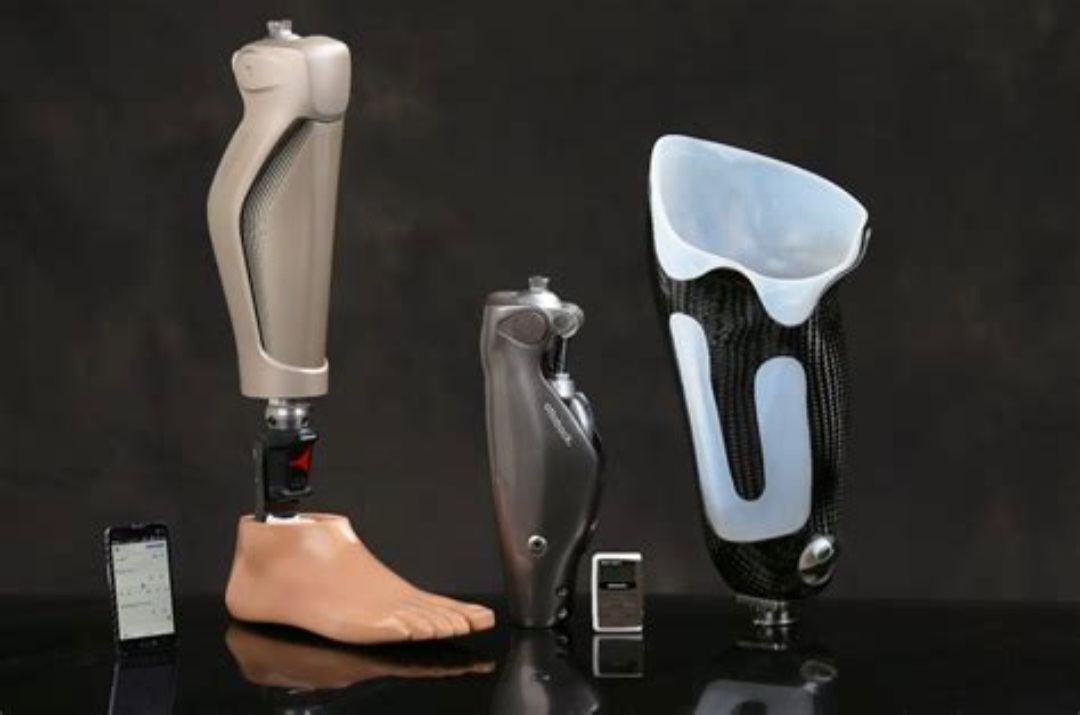
In the past few decades, even better alternatives to plastic have been found, such as aluminium, titanium, and silicone. Modern fitting techniques now help design comfortable and practical limbs tailored to the user’s needs.
There are 4 types of prosthesis depending on their localization:
- Transradial: Replaces limbs below the elbow.
- Transhumeral: For above-the-elbow replacement.
- Transtibial: Below-knee solutions.
- Transfemoral: Above-knee solutions.
There are also 3 types categorized by their power origin:
- Body powered: The body controls the prosthesis (e.g., a cable moving from the shoulder to the prosthetic hand).
- Motor powered: These have buttons to control movement, such as articulating wrists or fingers.
- Myoelectric Powered: A new technology allowing limbs to be powered by electrical signals sent via electrodes on the skin.
Myoelectric Prosthetics: A New Chapter
In the early 1940s, physicist Reinhold Reiter developed the first model of what would become the myoelectric prosthesis. Other concepts were suggested by Professor Norbert Weiner in 1947 and developed at Guy’s Hospital in London in 1955. Soviet scientists were apparently the first to use transistors in a myoelectrically controlled prosthesis, leading to the “Russian Hand” used clinically in Great Britain and Canada.
These are powered by the brain. Sensors placed on the skin above residual muscles detect electrical signals from muscle contractions. These signals are amplified and processed by algorithms to control movement. While they offer higher dexterity and a realistic appearance, they face challenges like consistent signal detection and the need for frequent battery recharging. Price remains a barrier, though researchers are working to improve affordability.
Touch: A Reignited Sense
A major disadvantage for amputees is the loss of the sense of touch. However, by planting brain-computer interfaces (BCI) in brain areas responsible for movement and touch, users can now begin to “sense” what they are doing. While past tests only showed faint signals, newer studies have succeeded in mapping brain areas to add feeling to movement and shapes.
Conclusion
Artificial limbs have moved from purely aesthetic tools to bionic devices controlled directly by the brain. As technology advances, the future holds the promise of prosthetics that are not just tools, but a way to fully experience the world.



No responses yet